5 Protecting Identity and Status
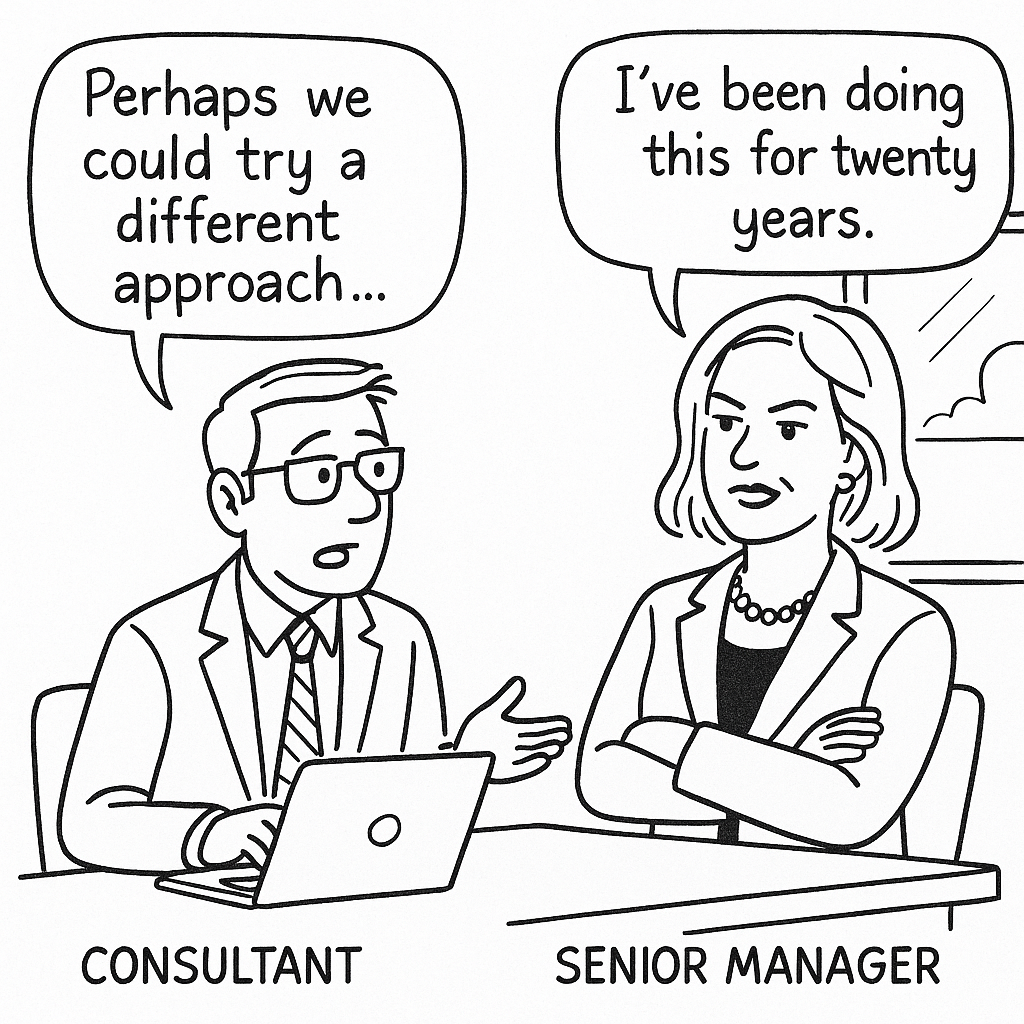
In many consulting engagements, resistance doesn’t appear as shouting or sabotage—it comes masked in politeness, perfectionism, or intellectual superiority. These games are defenses of identity, hierarchy, and status. They’re often played by leaders and experts who see your presence as a challenge to their place in the ecosystem. Recognising these games—and the animals behind them—lets you engage with subtlety, respect, and influence.
5.1 “We’re Totally Aligned (Except We’re Not)”
- Zoo Types: 🐴 Horse (dutiful performer), 🐍 Snake (covert manipulator)
- Game Description: Teams smile and nod, yet deep misalignment festers beneath the surface.
- Payoff: Appears united while avoiding visible conflict or hard truths.
- Antidote: Use anonymous tools like dot voting, alignment surveys, or Likert-scale opinion maps.
- Zoo Strategy: Invite the 🐴 Horse to gently name potential derailers (“What risks are we underestimating?”). Privately ask the 🐍 Snake, “What’s not being said here?” and integrate their input through process rather than position.
5.2 “Goldilocks Feedback”
- Zoo Type: 🦚 Peacock (perfectionist, image-conscious)
- Game Description: Feedback loops endlessly: “too simple,” “too complex,” “too soon,” etc.
- Payoff: Maintains control over deliverables and avoids commitment.
- Antidote: Co-create definitions of “good enough,” “ready,” and “done” before feedback begins. Ask, “Are we optimising or avoiding a decision?”
- Zoo Strategy: Validate the 🦚 Peacock’s high standards, but introduce delivery thresholds and the value of “minimum lovable product.”
5.3 “We Love Your Framework—Ours Is Just Different”
- Zoo Type: 🦉 Owl (custodian of internal logic)
- Game Description: Your expertise is appreciated… but must be translated into their model.
- Payoff: Maintains intellectual ownership and brand equity.
- Antidote: Translate your concepts into their language and mental models. “If we called this a ‘control insight’ rather than a ‘recommender,’ would that help?”
- Zoo Strategy: Treat the 🦉 Owl with respect. Don’t fight their framework—become a friendly interpreter.
5.4 “Strategy, Not Tactics”
- Zoo Type: 🦅 Eagle (visionary, detached)
- Game Description: Engages at lofty levels and avoids operational commitments by declaring all else “tactical.”
- Payoff: Retains strategic status, avoids operational entanglement.
- Antidote: Frame your tactical recommendations within a strategic narrative. Use phrases like “enabling agility” or “delivering on intent.”
- Zoo Strategy: Speak 🦅 Eagle. Then show how a pilot or dashboard supports the big picture.
5.5 “My Way Is the Only Safe Way”
- Zoo Type: 🐻 Bear (protective authority figure)
- Game Description: Resists new ideas unless they reinforce their authority and protect their people.
- Payoff: Maintains trust, control, and reputation.
- Antidote: Suggest small experiments where the Bear co-leads. “Let’s try a sandbox approach—with you as the sponsor.”
- Zoo Strategy: Never confront the 🐻 Bear. Reframe the experiment as legacy enhancement, not challenge.
5.6 Meta Insight: Ego Is a Proxy for Fear
These status-preserving games are not about vanity—they’re about protection. The Horse fears blame, the Owl fears irrelevance, the Peacock fears ridicule, the Eagle fears entrapment, and the Bear fears letting others down.
As a consultant, your role is to lower the stakes, mirror the intent, and introduce safety through structure—not confrontation.
🪞“When you meet resistance, ask not ‘How do I win?’—but rather ‘What identity is being defended here?’”