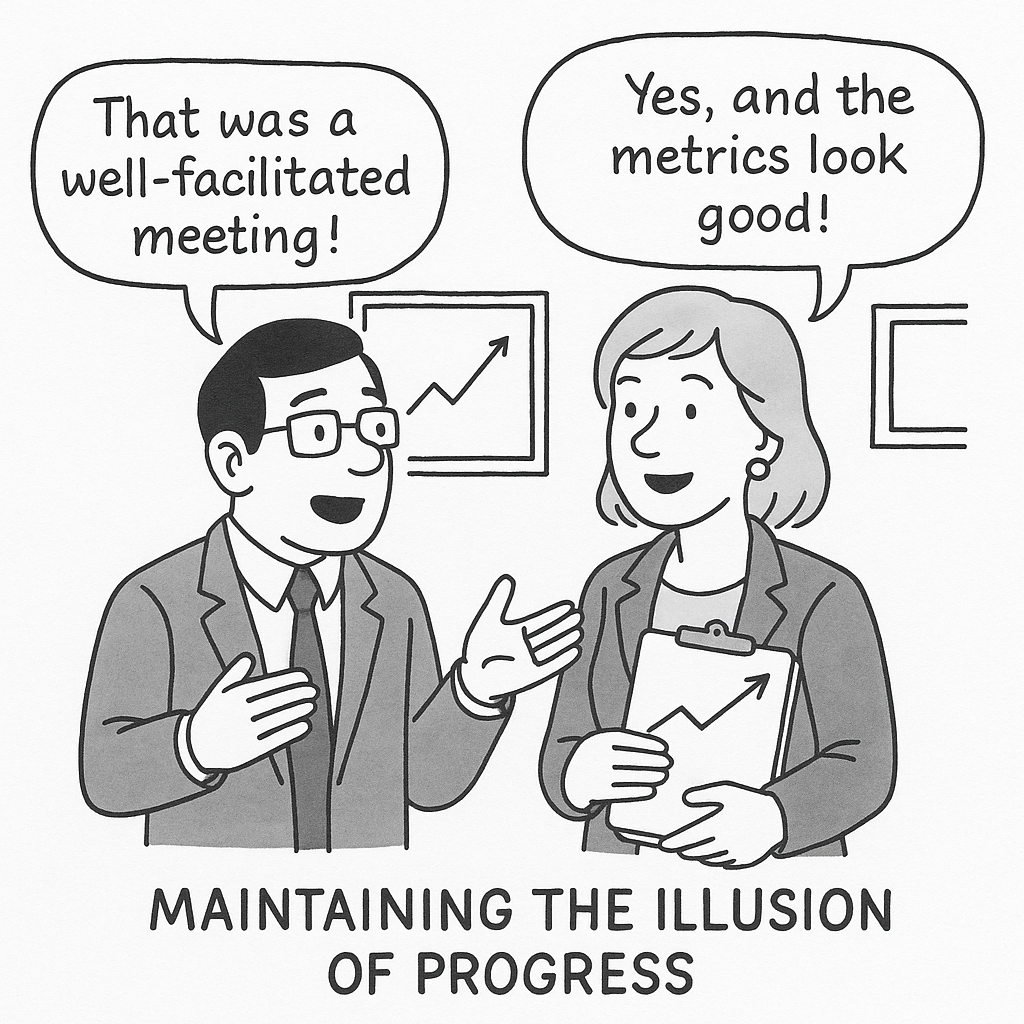
4 Maintaining the Illusion of Progress
In complex consulting environments—especially within large organisations—progress often wears a convincing mask. Well-facilitated meetings, polished dashboards, and endless “alignment sessions” can give the impression of momentum. Yet beneath this surface lies a dynamic of avoidance, ambiguity, and unresolved tension.
This section explores the behavioral “games” consultants frequently encounter when clients appear to be moving forward, but are actually maintaining the status quo. Drawing inspiration from The Organisational Zoo by Arthur Shelley, each game is linked to a zoo archetype that helps illuminate the psychology behind the behavior.
Understanding these patterns allows the consultant not to confront directly, but to redirect with empathy and structure—turning passive resistance into authentic engagement.
4.1 Game: “Let’s Circle Back Forever”
- Zoo Type: 🐨 Koala (passive resister)
- Game Description: Conversations go in circles with enthusiasm but no outcomes. Action is perpetually deferred under the guise of needing “more alignment” or “additional review.”
- Payoff: Appears engaged while quietly maintaining status quo.
- Antidote: Use decision deadlines, publish action logs, and frame indecision as a decision to stall.
- Zoo Strategy: Escalate gently. Create safe space for accountability. Invite others to respectfully challenge the Koala’s delay behavior.
4.2 Game: “The Golden Metric”
- Zoo Types: 🐘 Elephant (legacy loyalist), 🐂 Bull (metric bulldoser)
- Game Description: Team clings to the idea that one all-powerful KPI can solve every problem or justify every action.
- Payoff: Oversimplifies complex systems, defers difficult trade-offs, and creates false clarity.
- Antidote: Educate on metric ecosystems: leading vs. lagging indicators, triangulated dashboards, and context-aware thresholds.
- Zoo Strategy:
- Speak to the Elephant’s reverence for institutional knowledge by connecting new metrics to existing frameworks.
- Channel the Bull’s drive into fast feedback loops that allow learning without rigidity.
- Speak to the Elephant’s reverence for institutional knowledge by connecting new metrics to existing frameworks.
4.3 Game: “Executive Hide-and-Seek”
- Zoo Type: 🐅 Tiger (powerful but elusive)
- Game Description: Senior leader claims to back the initiative but is never present for key meetings or visible decision-making.
- Payoff: Preserves deniability and avoids taking responsibility for failure.
- Antidote: Require visible sponsorship. Postpone high-stakes phases until the Tiger is in the room.
- Zoo Strategy: Engage the Tiger with respectful escalation. Frame their presence as a sign of strategic importance, not operational meddling.
4.4 Game: “We’re All In (Unofficially)”
- Zoo Type: 🐺 Wolf (loyal but political)
- Game Description: Mid-level leader expresses strong private support but refuses to sponsor the initiative publicly.
- Payoff: Retains internal alliances and avoids political exposure.
- Antidote: Ask for clarity: “Can you support this openly, or would you prefer to stay in the background?” Document responses.
- Zoo Strategy: Help the Wolf craft a formal stance that aligns with their pack mentality—allowing them to lead without losing face.
4.5 Game: “Just Between Us”
- Zoo Type: 🦝 Raccoon (influential shadow operator)
- Game Description: Offers insider information, secret support, or soft vetoes off the record. Often whispers agreements no one else can see.
- Payoff: Gains invisible influence while avoiding scrutiny or responsibility.
- Antidote: Institutionalise transparency. Don’t act on unrecorded agreements. Use inclusive working sessions and shared logs.
- Zoo Strategy: Acknowledge the Raccoon’s value quietly but invite them into the light by giving credit when they act publicly.
4.6 Meta Insight:
The illusion of progress is often more seductive than progress itself—especially in political or high-risk environments. These games thrive when teams confuse activity with effectiveness or access with authority. The Organisational Zoo reminds us: the presence of intelligent, engaged animals doesn’t guarantee transformation—only that the habitat is well-decorated. As consultants, our work is to create environments of truth and traction: where decision-makers show up, support is visible, and progress is measured in actions—not just slides.
🪞 To break the illusion, we must surface the roles, confront the rituals, and respectfully nudge the creatures toward authentic commitment.