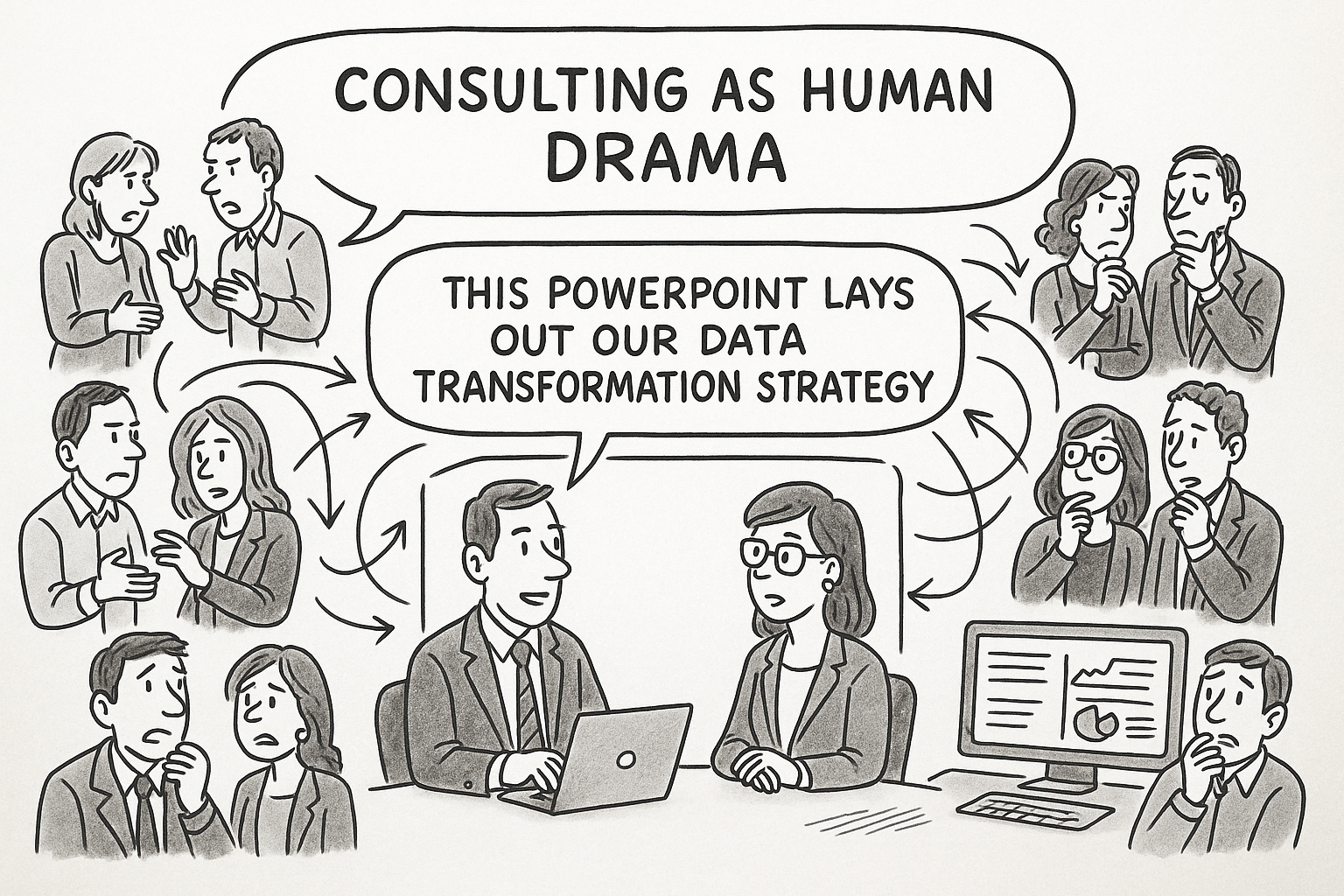
Consulting as a Human Drama
In every consulting engagement—whether focused on data transformation, strategy alignment, or cultural change—something deeper is constantly in motion beneath the surface of deliverables. While PowerPoints are refined and dashboards deployed, clients and consultants alike participate in a complex web of interpersonal “games.” These are not merely inefficiencies or communication quirks—they are structured, patterned behaviours that serve unconscious psychological and political purposes.
This chapter combines insights from Eric Berne’s Transactional Analysis with Arthur Shelley’s Organisational Zoo to explore how these games manifest in the wild terrain of data and management consulting. Each game is not just a tactic; it’s a dance between personalities, roles, and fears. By mapping these games to Organisational Zoo archetypes—from the cautious Turtle to the status-conscious Peacock—we reveal the behavioural subtext behind common consulting challenges.
The taxonomy is structured around six core psychodynamic themes:
- 🔄 Avoiding Accountability
- 🌀 Deflecting Focus
- 🧨 Externalizing Blame
- 🧩 Maintaining the Illusion of Progress
- 🎭 Protecting Identity and Status
- 👻 Resistance Disguised as Neediness
Each section introduces:
- A consulting game in context
- Its relevant Zoo archetype(s)
- The psychological payoff for the client
- A strategy for the consultant to shift the dynamic
🌪 Beyond Behavior: Understanding the Deeper Currents
This is not simply a book about client quirks. It’s about the psychodynamics of organisations, the unspoken emotional contracts beneath professional roles, and the hidden forces that shape decision-making in complex ecosystems.
🧠 Theoretical Triad:
- Transactional Analysis (Eric Berne): Why people repeat dysfunctional interactions.
- Organisational Zoo (Arthur Shelley): How people adopt survival archetypes under pressure.
- Psychodynamic Consulting: How unconscious emotions shape business behaviour.
These frameworks come together to reveal that clients aren’t being “difficult”—they’re playing out strategies of protection, identity, and status that they’ve learned to survive in organisational life.
🎭 Meta-Themes That Shape the Zoo
1. The Dual Reality of Professional Life
- The Zoo vs. The Clearing: Outer performance vs. inner truth
- Framework vs. Feeling: Rational tools vs. emotional undercurrents
- Role vs. Soul: The expert mask vs. the vulnerable self
🎯 What This Book Offers
- A taxonomy of consulting games rooted in emotional payoffs
- Animal-based archetypes to simplify behavioral complexity
- Strategies to de-escalate, reframe, and transform interactions
- A humane, playful lens to view client resistance—not as opposition, but as adaptation
This work is not about taming the zoo. It’s about making peace with its rhythms, illuminating its patterns, and co-creating spaces where truth and transformation can coexist.
🔮 Final Word: The Instinct to Understand
At its core, this is a book about the deep human need to make sense of what lies beneath the surface—both in others and in ourselves. The consulting zoo is filled with games, yes. But each game is also a cry for clarity, a bid for safety, or a defence against shame.
To navigate it well is not just to play the role of a consultant—but to become a mirror, a witness, and an integrator of the fragmented selves that emerge under pressure.
Welcome to the Consulting Zoo. Watch carefully. Listen deeply.
The creatures are not what they seem—but every one of them has something to teach.