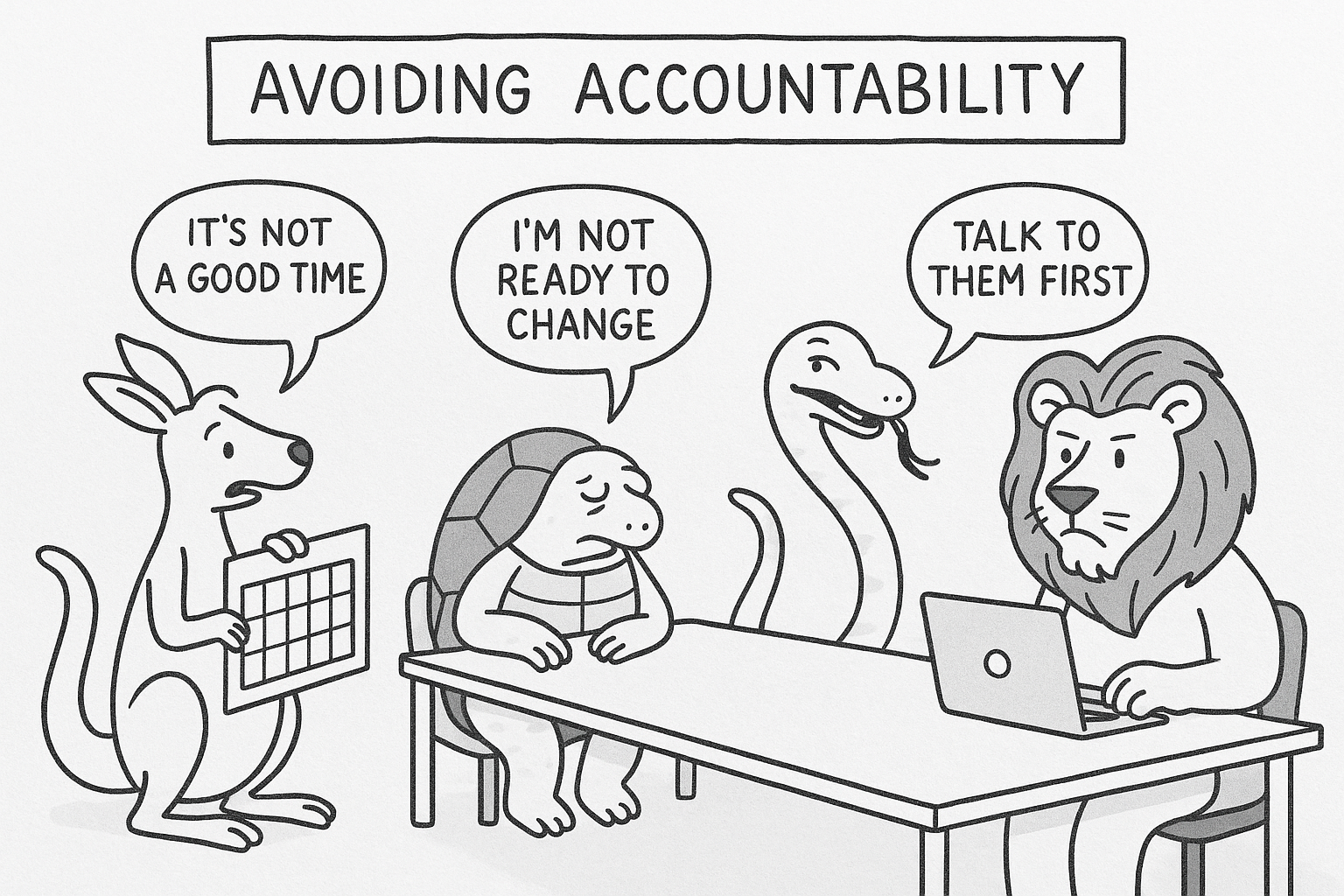
1 Avoiding Accountability
Organisations often invite external consultants with an appearance of openness to change, yet subtly resist engagement to protect familiar dynamics. These behaviors are not just passive obstacles—they are strategic “games” that preserve individual control, shield teams from discomfort, or outsource the burden of decision-making. Understanding the animal archetypes behind each behavior helps consultants engage more effectively with the underlying psychology.
1.1 Game: “We Brought You in to Ignore You”
- Zoo Archetypes: 🦒 Giraffe (aloof visionary), 🦔 Hedgehog (defensive executor)
- Description: Consultant is formally engaged, yet subtly excluded from influence.
- Payoff: Symbolic progress without disruption.
- Antidote: Contract for shared decision-making and delivery milestones.
- Zoo Strategy: Appeal to the Giraffe’s strategic goals; create clarity for the Hedgehog through structured agreements.
1.2 Game: “Can You Facilitate Us into Agreement?”
- Zoo Archetypes: 🦜 Parrot (talkative deflector), 🐍 Snake (manipulative controller)
- Description: Consultant is tasked with resolving conflicts others avoid.
- Payoff: Avoids direct responsibility and preserves fragile team cohesion.
- Antidote: Clarify facilitator boundaries and assign internal ownership for resolution.
- Zoo Strategy: Provide structure for the Parrot to channel energy; expose the Snake’s process gaps through transparency.
1.3 Game: “We Already Tried That”
- Zoo Archetypes: 🐘 Elephant (institutional memory), 🦔 Hedgehog
- Description: Historical failures are used to invalidate current solutions.
- Payoff: Maintains safety by avoiding risk and re-engagement.
- Antidote: Introduce “safe-to-fail” pilots to reduce fear of repetition.
- Zoo Strategy: Honor the Elephant’s memory while framing learning as evolution; support the Hedgehog with low-risk experiments.
1.4 Game: “The Lone Wolf Justified”
- Zoo Archetype: 🐺 Wolf (autonomous, mission-driven, tribal)
- Description: Decisions are made unilaterally to avoid delay or challenge.
- Payoff: Preserves autonomy, avoids friction or compromise.
- Antidote: Ask, “How will this scale without you?” Offer delegation pathways.
- Zoo Strategy: Position collaboration as strength, not compromise; frame support roles as force multipliers.
1.5 Game: “I Protect So I Control”
- Zoo Archetype: 🐻 Bear (protective, dominant, overparenting)
- Description: Leader withholds access or decisions under the guise of protecting the team.
- Payoff: Maintains control while appearing benevolent.
- Antidote: Frame transparency as empowerment. Ask: “What are you protecting them from?”
- Zoo Strategy: Acknowledge the Bear’s good intent, then co-design gradual exposure strategies that support team resilience.
1.6 Meta Insight
All these games share a core feature: the reluctance to share power and vulnerability. Whether masked as vision, protection, independence, or memory, each game seeks to avoid the perceived risk of joint ownership. The true consulting leverage lies in co-creating safe yet firm accountability structures—ones that respect individual motives while encouraging systemic trust and distributed leadership. When done well, this process turns protective instincts into collaborative transformation.