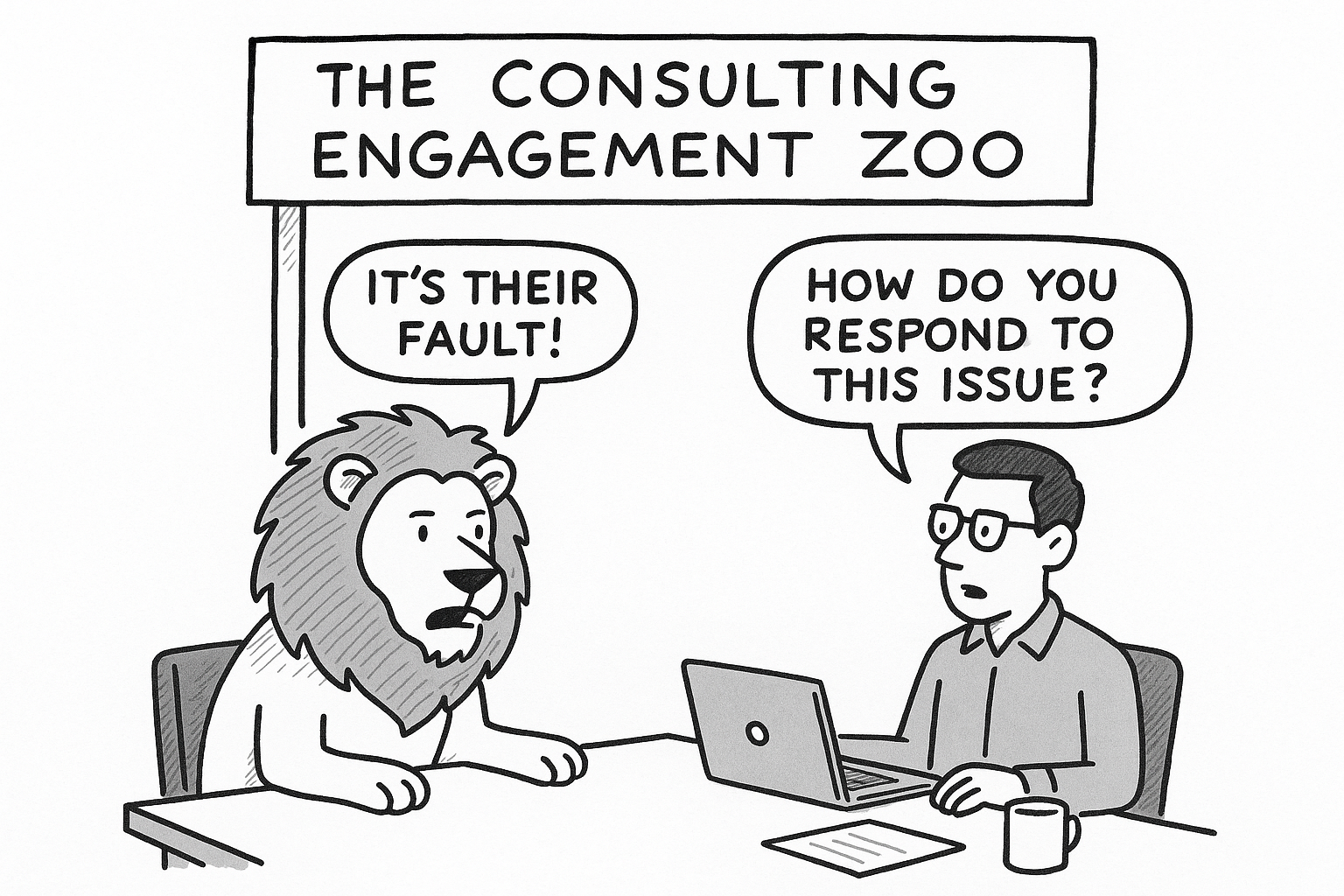
3 Externalising Blame
In the consulting engagement zoo, some clients instinctively shift responsibility away from themselves to protect ego, deflect scrutiny, or maintain control without risk. This is not always conscious—it often emerges from an organisational culture that punishes vulnerability and rewards surface-level certainty.
These consulting games represent strategies of blame deferral, where individuals or teams play hot-potato with decisions, commitments, and consequences. By understanding the archetypal animal behaviors behind these games, consultants can navigate this terrain with empathy, structure, and firm boundaries.
3.1 Game: “You’re the Expert, You Tell Us What We Want”
- Zoo Type: 🐓 Rooster (ego-driven) + 🐢 Turtle (withdrawing stakeholder)
- Description: The client praises your expertise while quietly abdicating ownership of direction, scope, or impact. When results are questioned later, you become the fall guy.
- Payoff: Transfers risk and accountability; maintains illusion of openness.
- Antidote: Flip the dynamic early: “What will you take responsibility for before we begin?”
- Zoo Strategy: Feed the Rooster’s need for recognition, then return the microphone. Coax the Turtle into the open with gentle, non-threatening invitations like: “Your perspective would add real value here.”
3.3 Game: “Boil the Ocean, But Do It by Friday”
- Zoo Type: 🐂 Bull (impatient driver) + 🐙 Octopus (many-tentacled distractor)
- Description: The consultant is handed a massive, undefined brief with urgent delivery pressure. Every time you clarify scope, new elements are added.
- Payoff: Diffuses accountability by overloading scope and complexity.
- Antidote: Use “stoplight scoping” (Must, Should, Could). Ask: “If we only had one week, what’s the red priority?”
- Zoo Strategy: Channel the Bull’s drive into clearly defined goals. Disentangle the Octopus’s distractions into parallel (not critical path) workstreams.
3.4 Game: “The Escalation Bounce”
- Zoo Type: 🦘 Kangaroo (jumpy, reactive, avoids stillness)
- Description: Instead of committing or resolving issues, this archetype escalates the issue up the chain—or jumps horizontally to a peer leader—thus dodging decisions.
- Payoff: Defers accountability while appearing productive.
- Antidote: Anchor in governance: “Is this within your decision scope?” or “Who owns the outcome of this call?”
- Zoo Strategy: Slow the Kangaroo down with pre-agreed escalation pathways and reflective frameworks. Require written confirmations to create friction for mindless escalation.
3.5 Game: “I’m Too High-Level for This”
- Zoo Type: 🦅 Eagle (strategic, lofty, detached)
- Description: The Eagle floats above the engagement, offering occasional commentary but avoiding commitment to real decisions—especially those with trade-offs.
- Payoff: Retains status and influence without risk.
- Antidote: Pull the Eagle in early: “We’re shaping the foundation now—your perspective is critical to align our direction.”
- Zoo Strategy: Speak to the future. Engage the Eagle by mapping implications, strategic fit, and long-term effects rather than today’s details.
3.6 Meta Insight
In cultures where accountability feels like vulnerability, blaming the consultant becomes a survival strategy. These games are not personal—they are protective reflexes of organisational systems seeking control without consequence.
To move beyond these dynamics, the consultant must do more than deliver—they must model mutual ownership. This means setting up working agreements, contracting clearly on roles, and not rescuing clients from decisions they need to make.
Understanding the zoo animals behind the games gives consultants a language of compassion and clarity—a way to move from blame to collaboration without triggering shame or ego defenses.