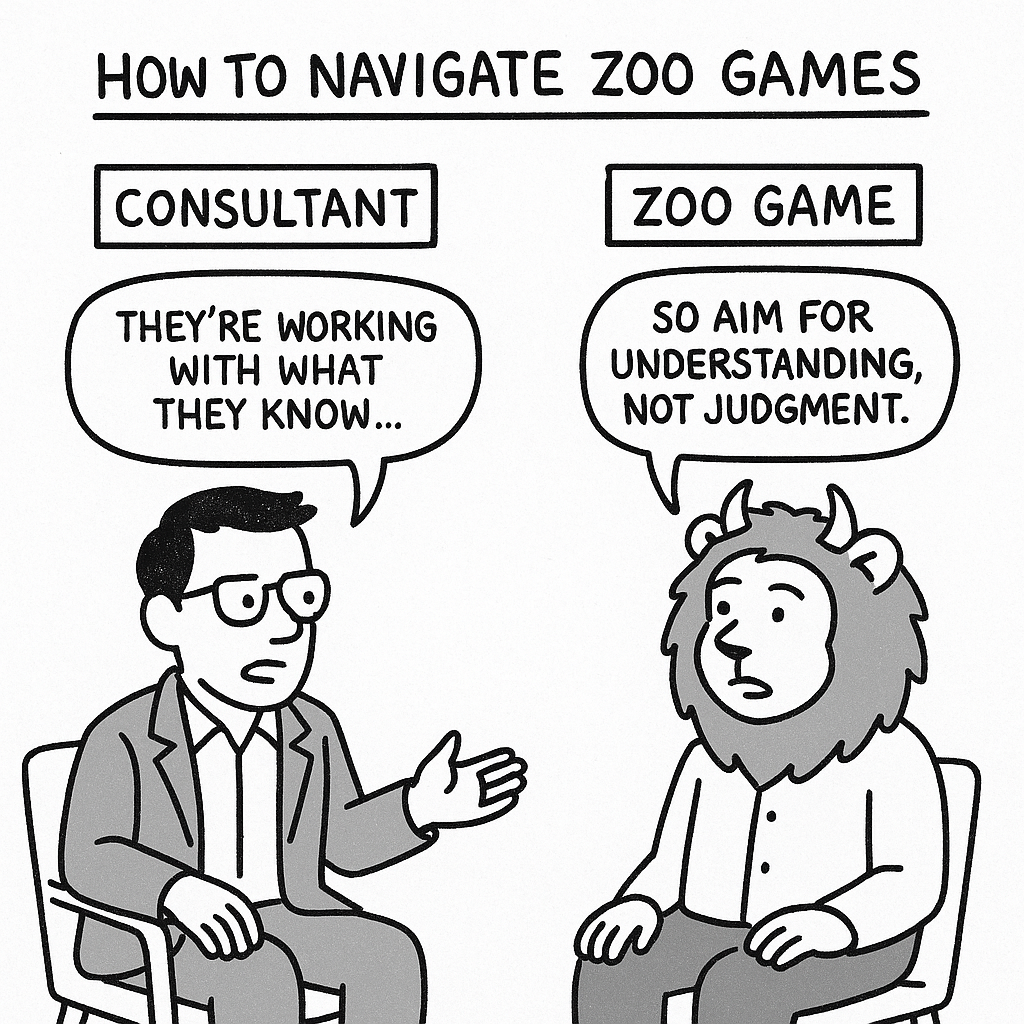
7 How to Navigate Zoo Games
In the consulting zoo, you are not merely solving technical problems—you are navigating behavioral ecosystems. The games clients play are rarely malicious; they are adaptive responses to complexity, power, fear, and change. Below is an expanded guide for identifying and working with common patterns that emerge in these environments.
| Pattern | Recommended Approach |
|---|---|
| Pace Mismatch | 🕰️ Introduce “rhythm contracts” that align tempo and depth. Decide together whether you’re building sprints or root systems. Ask: “Would you prefer fast and visible progress, or slower but lasting transformation?” |
| Shadow Influence | 🕵️ Use stakeholder maps and visibility matrices to detect informal power. Ask: “Who influences outcomes, even if they’re not in the room?” Engage shadow players early—Raccoons, Snakes, and Foxes prefer backchannel trust. |
| Emotional Derailment | 🌀 Translate emotion into business relevance. Name feelings, then link them to organizational risk: “You seem frustrated—what outcome might be in danger here?” Let emotional energy fuel, not derail, the work. |
| Power Dynamics | 👑 Secure permission to explore “unspoken contracts.” Use phrases like: “Would it be helpful to explore what we’re not saying that might shape this work?” This brings Snakes and Tigers into the light. |
| Conflict Avoidance | 🫥 Use metaphor and safe proxies. Ask, “What would the Owl say?” or “If we were being completely honest like a Giraffe, what might we name?” Create narrative distance so truth can emerge safely. |
| Dependency Framing | 🐶 Beware of excessive gratitude and requests for hand-holding. Say, “It’s great you trust the process—now where would you like to start taking the lead?” Frame independence as a milestone. |
| Facade of Agreement | 😐 Detect false harmony by watching body language and what isn’t said. Ask: “Are we nodding yes, or meaning yes?” or “If there were an unspoken no in the room, what would it be?” |
| Ambiguity Weaponized | 🌫️ When ambiguity is used to delay, defer, or protect turf, bring contrast. Use polarity questions like: “On a scale from clarity to confusion, where are we?” or “What would total clarity look like right now?” |
| Data as Armor | 📊 When clients hide behind dashboards, charts, or “just one more analysis,” return to purpose: “What decision are we avoiding by analyzing this again?” Ask: “Is this helping us choose, or helping us postpone?” |
| Premature Solutioning | 🧪 When clients jump to tech or process before framing the real problem, slow them down with a question: “If this works exactly as planned, what deeper issue might remain untouched?” |
| Savior Seeking | 🧑🚒 When the consultant is cast as the rescuer, redirect the energy: “I can partner with you, but not do it for you. Where are you already strong, and where do you need reinforcement?” |
| Saboteur in Sheep’s Clothing | 🐑 + 🐍 When a participant nods politely but blocks subtly, name the behavior neutrally: “You’ve raised some great questions—are they rooted in curiosity, concern, or challenge?” This invites honest repositioning. |
| Busyness Theater | 🎭 When output trumps outcome, create a pause: “If we paused all effort for 2 weeks, what would break?” or “What’s the difference between movement and momentum here?” Highlight purpose over productivity. |
7.1 Common Tools Across Patterns
- Metaphoric Detours: Animal archetypes, storytelling, polarity mapping
- Micro-contracting: Explicitly agree on tone, ownership, and rhythm in real-time
- Power + Safety Balancing: Create space for challenge and compassion
- Feedback Surfacing: Regularly ask: “What’s not working that we haven’t said yet?”
7.2 Key Mindsets for the Consultant
- Curiosity over Control – Watch the game without trying to stop it immediately.
- Invitation over Imposition – Ask if the group is ready to name or shift something.
- Structure over Emotion – Don’t suppress emotion—wrap it in ritual and reflection.
- Shared Ownership over Heroism – You are not there to fix. You are there to enable.
7.3 Final Thought: The Zoo Doesn’t Lie
Behavior is never random. Every game, every pause, every smile-that-avoids is an artifact of something deeper. The most powerful move you can make as a consultant is not to resist the game—but to understand its function, name its pattern, and gently offer a more courageous alternative.
Let the Zoo teach you. Then help it evolve.